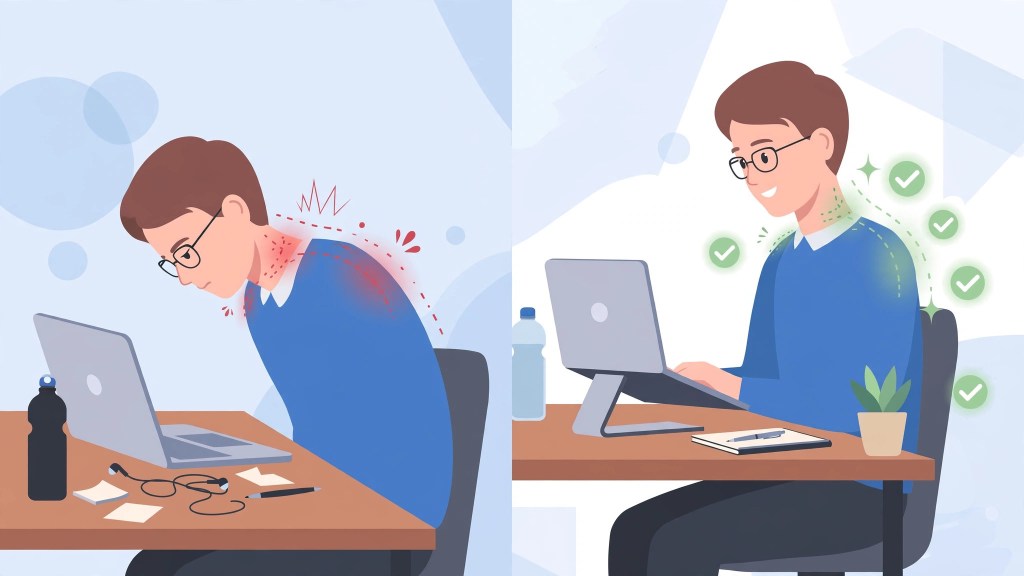
If you end most days with a stiff neck, aching shoulders, or a dull throb in your lower back, your posture is likely the culprit. We spend hours hunched over phones and laptops, yet the body was built to move. The good news: it is one of the most fixable problems there is.
How Your Posture Controls Your Muscles
Think of your body as a stacked tower. Ears over shoulders, shoulders over hips, hips over ankles: in this alignment your muscles barely work to hold you upright. Slouching breaks that stack, and for every inch your head drifts forward, the effective weight on your neck rises by roughly ten pounds. Your head alone weighs about eleven pounds, so a forward head posture can force your neck to carry thirty or forty pounds all day.
Meanwhile your chest muscles tighten while the muscles between your shoulder blades stretch and weaken. Slouching also flattens the lower spine’s natural curve and overloads its small stabilizing muscles. This uneven pull is what Cleveland Clinic’s posture guide calls the starting point of most posture-related pain: some muscles overworked, others underused.
5 Everyday Posture Mistakes That Cause the Most Pain
- Text neck. Craning your head down to your phone for hours. The deeper the bend, the heavier the load on your neck.
- The desk hunch. Shoulders rolled forward, chin jutting toward the screen. The top cause of mid-back stiffness.
- The chair slouch. Sliding down so your lower back takes all the pressure. It weakens the core and irritates the lumbar discs.
- One-sided standing. Leaning on one leg or carrying a heavy bag on the same shoulder. The imbalance travels up and surfaces as hip or lower-back pain.
- Poor sleep posture. Stomach sleeping twists the neck for hours; a pillow too high or too flat keeps the spine bent all night.
Why the Pain Gets Worse Over Time
Posture pain rarely arrives all at once. It builds quietly. Tight muscles get less blood flow: less oxygen, slower recovery. Small knots called trigger points form in overworked muscles and refer pain elsewhere, which is why neck tension often arrives with headaches.
Your body compensates: when one muscle group gives up, another takes over, and soon that one hurts too. A stiff mid-back forces the neck to work harder; tight hip flexors from sitting tilt the pelvis and strain the lower back. This chain reaction is why MedlinePlus advises checking the whole body’s alignment when back pain keeps returning, instead of treating one sore spot alone.
Warning Signs You Should Not Ignore
Most posture pain improves with simple changes within two to three weeks. See a professional sooner for numbness or tingling in the limbs, pain shooting down an arm or leg, headaches starting at the base of the skull, pain that wakes you at night, or weakness when gripping or walking. These can signal disc or nerve involvement, which needs proper assessment rather than home stretches.
7 Simple Fixes You Can Start Today
- Move every 30 to 45 minutes. Stand, roll your shoulders, walk for a minute. Regular movement beats one perfect sitting position.
- Raise your screen to eye level. Monitor top at or just below eye level, an arm’s length away. Bring your phone up instead of bending your head down.
- Fix your chair. Feet flat, knees level with your hips, lower back supported. The U.S. Occupational Safety and Health Administration offers practical workstation setup guidance built on these principles.
- Do chin tucks. Sit tall, pull your chin straight back, hold five seconds. Ten reps twice daily retrains the deep neck muscles.
- Squeeze your shoulder blades. Pull them together and down, hold five seconds, repeat ten times. This wakes up the mid-back muscles typing puts to sleep.
- Strengthen your core and glutes. Planks, bridges, and bodyweight squats a few times weekly support your spine better than any chair.
- Walk daily. The simplest posture reset. It restores the spine’s curves and loosens everything sitting tightens.
When Home Fixes Are Not Enough
Here is the honest truth: if you have fixed your workstation, done the exercises, and pain still returns after two or three weeks, the problem is beyond self-help. Persistent pain usually means a deeper muscle imbalance, a stiff joint, or a movement pattern your body locked in years ago. A qualified physiotherapist does not just treat the sore spot; they find the root cause: which muscles are weak, which joints are stiff, and which daily habits keep reloading the pain, then build a plan around your body. It is the same root-cause approach described in how physiotherapy restores knee strength and mobility.
If you are dealing with stubborn posture-related pain, the top physiotherapists in Pakistan offer this kind of root-cause assessment, with doctor-led evaluations and personalized treatment plans. Getting expert eyes on your posture early can save months of recurring pain and stop a small imbalance from becoming chronic.
Frequently Asked Questions
Can poor posture really cause chronic pain?
Yes. Months or years of uneven loading change how muscles and joints function. Occasional stiffness becomes daily pain if the posture does not change.
How long does it take to fix bad posture?
Most people feel noticeable improvement within three to six weeks of consistent changes and exercises. Ingrained habits can take a few months to retrain.
Is it safe to crack my own neck or back?
Gentle movement is fine, but forceful self-cracking can irritate joints and ligaments. Needing to crack the same spot constantly means something needs professional attention.
Expert Tip: The 30-Second Wall Test
Stand with your back against a wall, heels about six inches away. Your head, shoulder blades, and buttocks should all touch the wall. If your head cannot reach it without tilting back, or there is a large gap at your lower back, your posture needs work. Repeat every Sunday evening. Thirty seconds, no equipment, and watching the gap shrink keeps you motivated.

